
 Dimitri Burkhard
Switzerland is getting new banknotes. And honestly, they sound like something worth getting excited about.
The Swiss National Bank has picked a winner for the next generation of Swiss francs. The new notes will look different, tell a new story, and come packed with even more security features. The catch? You will not be holding them until the early 2030s.
Here is everything you need to know.
Key Takeaways:
The SNB selected Lausanne-based Emphase Sàrl to design the 10th series of Swiss banknotes. The theme is "Switzerland and Its Altitudes" - from lowland river plains to high alpine peaks.
- Denominations (10, 20, 50, 100, 200, 1000 CHF) and colors stay the same.
- First notes enter circulation in the early 2030s, likely in 2031.
- The expert jury actually ranked a different design first - Zurich studio Marcus Kraft - before the overall evaluation led to Emphase winning
No midlife crisis for the current Swiss franc notes
The current ninth series launched between 2016 and 2019. The average lifespan of a Swiss banknote series is around 15 to 20 years. So, today's notes are actually still in perfectly good shape.
SNB president Martin Schlegel put it best back in October 2025: "I can assure you that the current notes are not having a midlife crisis."
That said, the development of a new series takes several years. While your 20-franc note is not going anywhere soon, the SNB is already deep into building its replacement. On March 4, 2026, SNB representatives Sébastien Kraenzlin and Antoine Martin announced the winner at the SNB's Zurich headquarters.
Six finalists were still in the running. The winners: Fabienne Kilchör and Sébastien Fasel from the Lausanne design studio Emphase Sàrl.
Why Switzerland Is Redesigning Its Banknotes
Switzerland takes its cash seriously. Dare I say more? Cash payments have declined from 70 percent in 2017 to 30 percent. Yet, most Swiss people want to keep cash around. I always carry cash in my wallet, although I am guilty of using credit cards or Twint most of the time...
The SNB has a clear job: make sure banknotes stay secure, practical, and one step ahead of anyone trying to fake them. That means regularly updating the series with better technology, better security features, and a fresh design.
The current ninth series, designed by Zurich graphic artist Manuela Pfrunder, launched between 2016 and 2019. It was a big deal at the time, and it still holds up.
But then again, technology moves fast. You can read about what made the ninth series so impressive in our post on the security features of Swiss banknotes. The tenth series now has to raise that bar.
There is also a political backdrop. On March 8, 2026, Switzerland voted on a "cash initiative" that wanted to write coins and banknotes into the federal constitution. The Federal Council said no to the initiative but offered a counter-proposal to protect the SNB's duty to supply cash.
The SNB announced its winning banknote design just days before the vote. Now, whether or not this was coincidence or simply timing, it sent a clear message: the Swiss franc in physical form is not going away. And personally, I'm glad, because I have so many memories of Swiss coins and bills going all the way back to my childhood...
Emphase Wins the Swiss Banknote Design Competition
The new series will be designed by Emphase Sàrl, a studio from Lausanne run by Fabienne Kilchör and Sébastien Fasel. Their concept, called Concept J, came out on top after a serious competition.
Here is how it worked:
- More than 300 designers applied
- 12 studios were invited to submit full concepts
- A six-member expert jury evaluated all 12 proposals
- Over 100,000 people voted in a public survey
- Concept J landed in the top three in both the jury and public rankings
- When commercial and organisational criteria were added, Concept J had the best overall result
The jury included specialists from the University of St. Gallen, the Federal Office of Culture, and Swiss design and printing organisations. This was not just a vote on what looks nice. It was a serious assessment covering design quality, technical feasibility, and real-world production.
Emphase now has a formal mandate to develop the entire tenth series along with the SNB's internal specialists.
"Switzerland and Its Altitudes"
(What the Theme Actually Means)
Every studio in the competition worked with the same brief from the SNB: "Switzerland and Its Altitudes." (German: Die Schweiz und ihre Höhenlagen)
The idea is to take Switzerland's most defining physical feature (around 70 percent of the country is mountains) and turn it into a visual system across all six denominations. From the flattest lowlands to the highest peaks, each note belongs to a different altitude zone.
Here's a breakdown of what this means:
- Smaller denominations (CHF 10, CHF 20) connect to low-altitude environments: the Mittelland, rivers, the Jura
- Mid-range values (CHF 50, CHF 100) cover pre-alpine areas, lakes, and hillside towns
- Higher values (CHF 200, CHF 1000) go all the way up into the Alps: glaciers, rock faces, high passes
Pick up a 10-franc note and you are at the river. Pull out a 1000-franc note and you are at the summit. Kinda cool, right?
The current ninth series was built around abstract concepts: time, light, and communication.
The upcoming tenth series drops any abstraction and goes straight to the physical landscape. In my opinion, it's a shift in how Switzerland wants to present itself on its own money.
What the New Swiss Banknotes Will Look Like
Drumrolls, please... Each new banknote in Concept J has two distinct sides, and here is what they will feature:
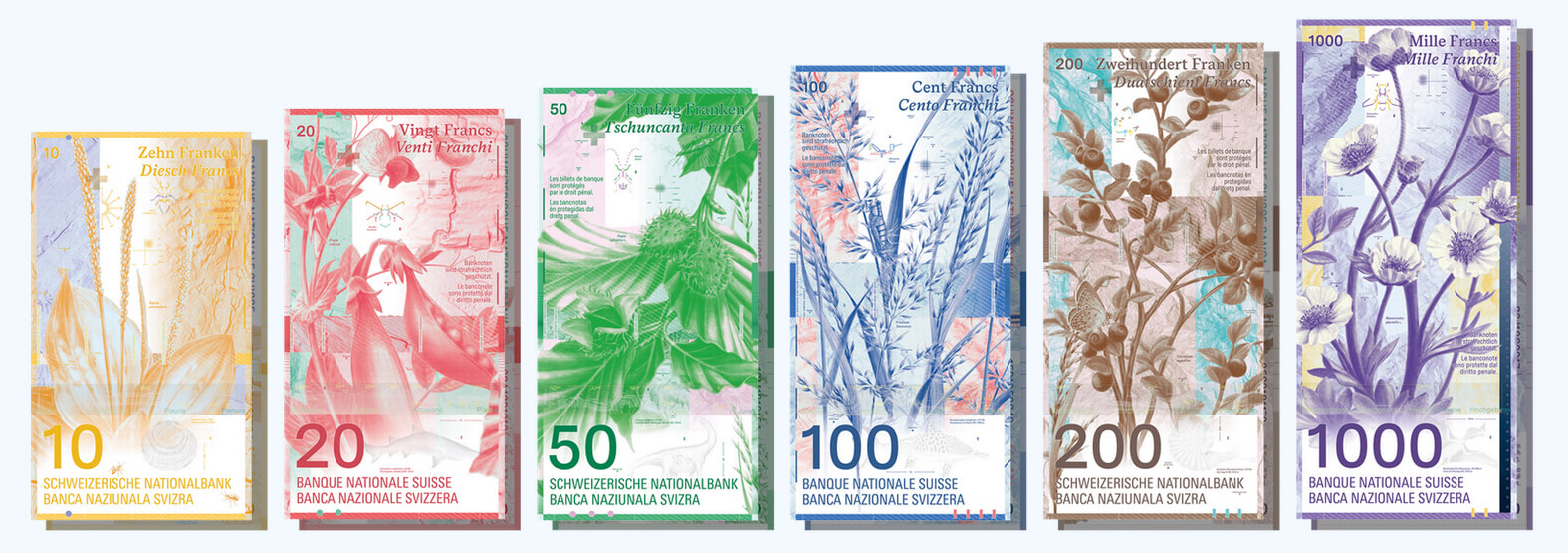
Front: Native Swiss Plants and Nature by Altitude
One face of every note shows native plants, flowers, and small creatures. Think insects, pollinators, and species that live at that specific altitude.
The illustrations are detailed and fine-lined, designed to work together with microtext and security features layered underneath.
This turns each note into a small field guide. Meadow plants on the lower denominations, alpine flora on the higher ones. For a country where nature is central to both daily life and tourism, this feels like a "natural fit" - no pun intended.
Back: Landscapes, Buildings, and Swiss Public Transport
The reverse side puts human life at that same altitude on display:
- Architecture typical to each elevation, from lowland farmhouses to alpine huts and the Jungfraujoch station.
- Cultural references connected to how people actually live and work at that altitude.
- Swiss public transport and mobility, from the Glacier Express train to cable cars, mountain roads and tunnels. They are a kind of thread connecting all the altitude zones.
- Landscapes, from river bends to hillside villages, passes, and peaks.
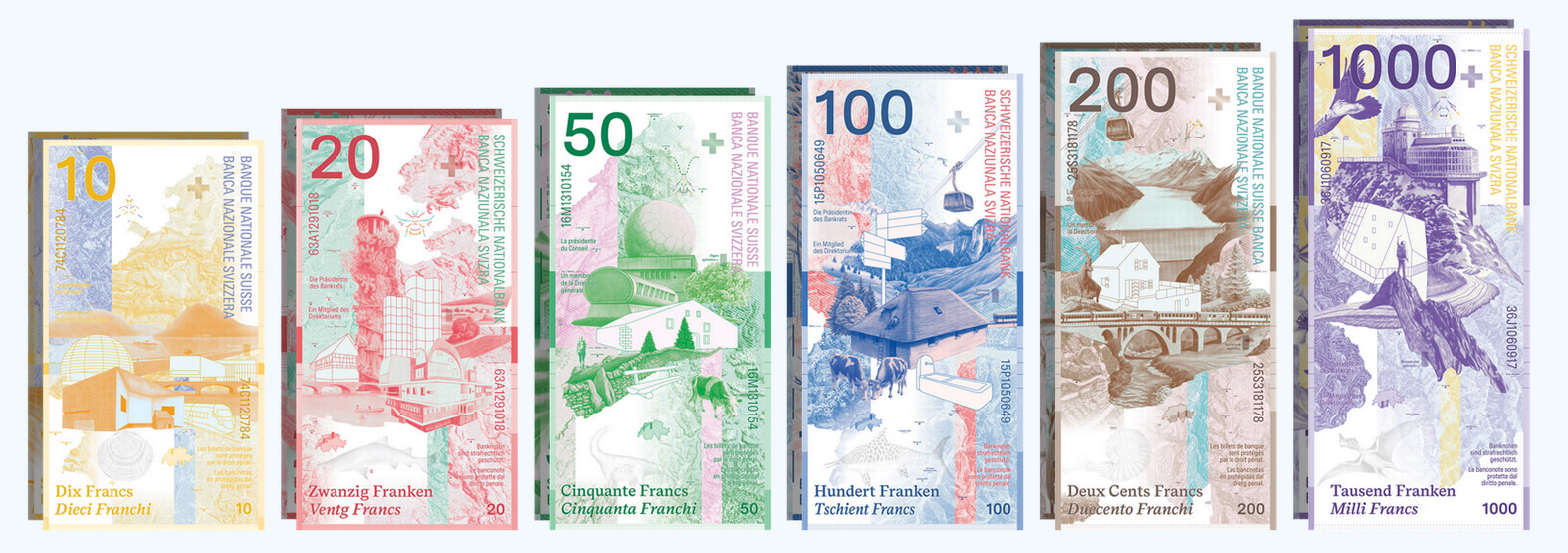
For anyone who has explored Switzerland by train, post bus, or cable car, this will feel familiar. The new Swiss banknotes basically double as a love letter to Swiss mobility.
Studio Marcus Kraft's "Rock and landscape as currency"
Here is where the story gets really interesting. The expert jury actually ranked the concept by Zurich-based Studio Marcus Kraft first.
But when the full evaluation (including commercial and organisational criteria) was factored in, Emphase's Concept J came out ahead overall.
Both proposals were seriously good, and the final call came down to criteria that go well beyond visual design.
Marcus Kraft's concept is called "Rock and landscape as currency." The idea is clever and direct: the Swiss franc is a hard currency, internationally known for stability and reliability. Switzerland is a country literally made of rock. Put the two ideas together and you get: rocks on money.
Marcus Kraft's "Hard as a Rock" would have looked unlike any banknote series in the world. Each bill would have featured a real stone collected at a specific Swiss altitude, photographed at full original scale with high precision.
Studio Marcus Kraft has since shared their concept publicly:
The Internet Had Its Own Ideas for New Swiss Banknotes
The SNB announcement sparked a wave of unofficial, tongue-in-cheek proposals on social media. And I have to say, some of them are genuinely fun. Or intricate, like the oneby Rigi Railways.
One that I particularly liked is from the city of Winterthur. A local account imagined what the new bills would look like if they were dedicated entirely to Winti landmarks: the Bruderhaus, the Roter Turm, the Bäumli, and the Affenschlucht all made appearances on mock-up notes in the familiar Swiss franc format.
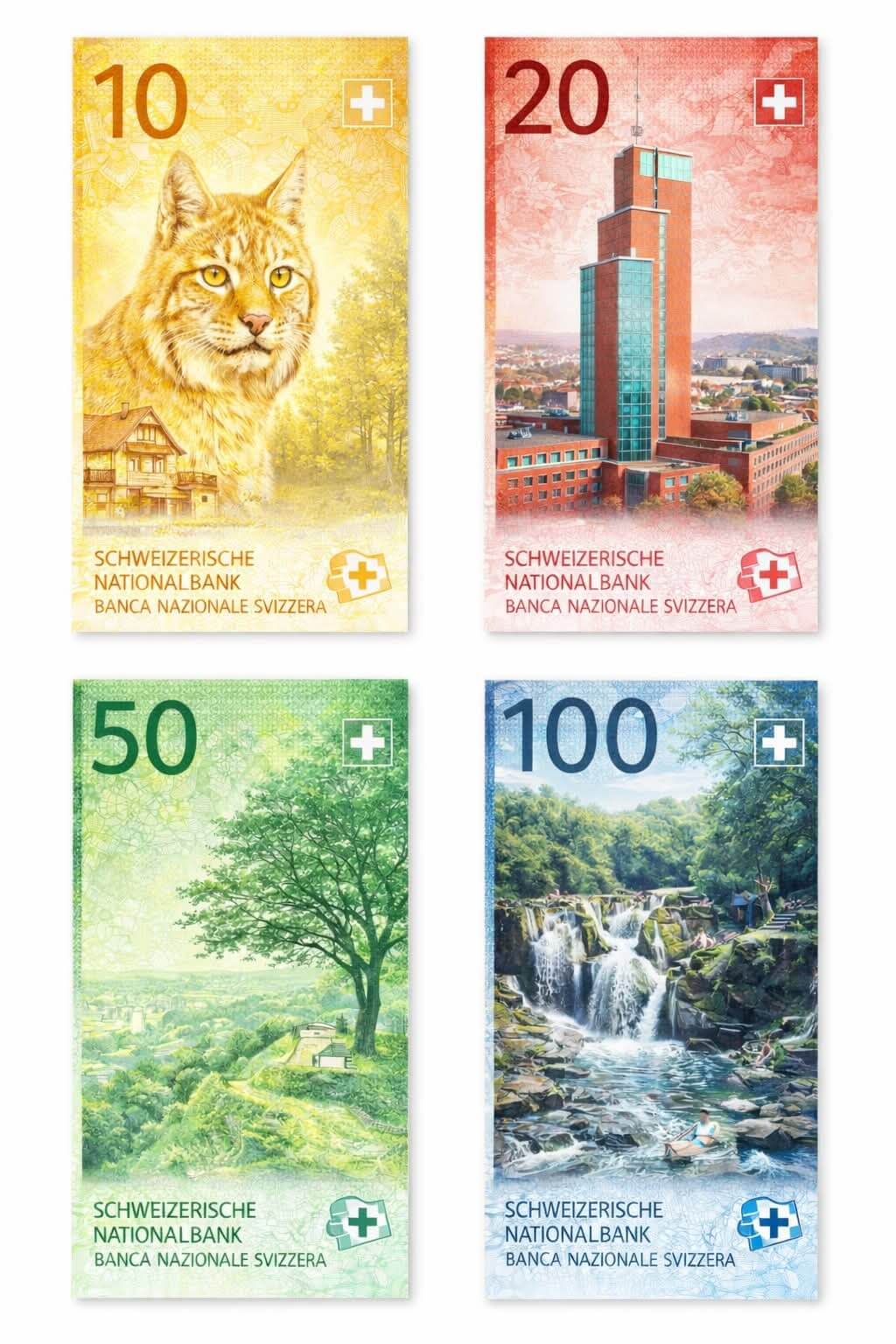
Colors, Denominations, and What Stays the Same
One of the most practical decisions in the new series: the familiar stuff does not change.
The SNB has confirmed:
- Denominations stay at 10, 20, 50, 100, 200, and 1000 francs
- The color scheme stays broadly consistent with the current ninth series
The yellow 10-franc note stays yellow. The red 20-franc note stays red. You will not need to relearn your money.
For residents, tourists, elderly people, and anyone who identifies notes by color at the checkout, this matters a lot. (Me!) The new design changes the visual story on each bill., but the main characteristics will stay the same.
When Will the New Swiss Franc Banknotes Actually Arrive?
Short answer: not before the early 2030s, likely in 2031. Here's why it takes that long:
Step 1: Graphic Development (1 to 2 years)
The competition concept goes into a phase of graphic refinement. Emphase and the SNB work together to adapt the design for real banknote production. Not everything that works in a competition renders well in industrial printing at scale. So, keep in mind that the final notes will likely differ from any competition visuals.
Step 2: Technical Development (approx. 2 years)
Security features get integrated. Substrates are selected. The notes are tested across machines, lighting conditions, and wear scenarios. Every ink, foil, and paper type has to work together and survive years of daily handling.
Step 3: Production Testing and Bank Council Approval
Before launch, the SNB runs full production tests and makes sure the new notes work in ATMs and cash-handling machines across Switzerland.
The Bank Council takes the final decision on the design, meaning what you actually get in your wallet in the 2030s could look different from Concept J as it stands today.
Expected Security Features on the New Swiss Banknotes
The SNB has not yet published the security spec for the tenth series. I think this is for the obvious reason that they don't want to give a head-start to forgers.
But looking at the current and past series of bills, Switzerland's track record speaks for itself. Swiss banknotes actually have one of the lowest counterfeiting rates in the world, at roughly 1 in 100,000 notes in circulation.
At the bare minimum, expect these security features on the tenth series:
- Watermarks and microprinting embedded in the fine botanical illustration work
- Tactile raised printing so denomination values can be felt by touch
- Holographic foils or transparent windows, a modern standard on high-security notes
- UV-reactive inks revealing hidden patterns under ultraviolet light
- Color-shifting elements that change at different viewing angles
- Machine-readable serial numbers for ATM and cash-machine compatibility
The dense botanical illustration style of Concept J is probaby way more than just a design choice. By overlapping lines and using incredibly small typography, these bills will be genuinely hard to scan and reproduce. Right there is another ingenious, built-in security layer, let alone all the dedicated anti-counterfeit features.
A Brief History of Swiss Banknote Series
Switzerland has issued nine complete banknote series since 1907. Each one is a snapshot of Swiss design thinking and security technology at that moment in time.
The eighth series was taken out of circulation in 2021 and is no longer exchangeable at the SNB. That's a useful reminder: old Swiss banknotes do eventually reach a hard deadline.
The ninth series introduced a new visual language built around abstract concepts, such as time, light, and communication. It also had some major security upgrades, including the tactile grey relief motif on every note. (Have you noticed it?)
The tenth series now switches from abstract ideas to actual geography. From what Switzerland stands for to what Switzerland looks like. That shift says something about where the country is in 2026. And about how it wants to present itself to the world for the next decade and beyond.
For more on Swiss money and how it works, check our earlier post entitled Money, Money, Money.